|
Himeji
Castle
World Cultural Heritage
|

From
the second half of the 15th century, rival
warlords in Japan were the masters of
their own regions. From around that time,
castles in Japan changed from being just a
military facility to a symbol of the
feudal warlord's power. Many beautiful
castles were built during this period.
Himeji Castle, inscribed on the World
Heritage List in 1993, has beautiful
whitewashed walls, and so it is also known
as the White Heron Castle.
|

In
1333 Norimura Akamatsu, the ruler of Harima
District, built a fort and in 1346, his son,
Sadanori built premises. After them, the
Kotera and Kuroda clans ruled the area. It is
said by some scholars that the original castle was
built in the middle of the 16th century when
Shigetaka Kuroda and his son Mototaka Kuroda ruled
the district. When Kanbei Yoshitaka Kuroda
ruled, Hideyoshi Hashiba came to the castle in order
to build his own three-storied castle. After
the Sekigahara Civil War the lord named Terumasa
Ikeda, son-in-law of the Shogun Ieyasu Tokuawa moved
into the castle to rule. His annual salary was
520,000 koku of rice (1 koku = 5 bushels). In
1601, Terumasa Ikeda started digging three moats
around the castle building and completed the whole
castle complex as it is in 1609. The outer
moat is just north of J.R. Himeji Station today.
After
the Ikedas, Tadamasa Honda added some buildings in
West Bailey. His annual salary was 150,000
koku of rice. The castle is believed to have
been completely finished in 1618. After the
Honda family there were other lords such as the
Matsudairas, the Sabakibaras, etc. Finally
Tadazumi Sakai came as the lord in 1749. His
descendants met with the Meiji Restoration in 1868,
when the Shogunite systems disappeared.
The
Main Tower with the smaller towers and corridors
connecting these towers have been registered as
national treasures. The Cosmetic Tower, 27 'yagura',
15 gates, and 1,000 meter-long earthen walls have
been registered as important cultural
treasures. A part of the middle moat, and the
whole inner moat remain as they were in the feudal
times. And the areas inside the middle moat
has been registered as a special historic site.
Himeji
Castle
68 Hon-machi, Himeji, Hyogo
Tel: 0792-85-1146
Entry:
9
a.m. - 4 p.m. (September - May)
9 a.m. - 5 p.m. (June -
August)
Closed:
Only for three days - 12/29 - 12/31.
Tour:
Approximately 1 1/2 hours
Access:
15 minute walk from J. R.
Himeji station
By car from Fukusaki
Intersection of Chugoku Expressway


Curved Stone Wall with A
Folding Fan Shape
The lower part of the wall has
a gentle slope, but it becomes steeper toward the
top to defend against invaders climbing up on it.


Four seasons of the Himeji
Castle
Spring: There are about
1,000 cherry trees around Himeji castle. They are in full bloom from the end of March to the
beginning of April.
Summer:
Bright sunshine
with big green trees.
Autumn:
Crimson leaves of
the maple trees.
Winter : From January
until
February, you may see the castle covered in a
blanket of snow .

Sightseeing
Spots Around Himeji City
Himeji City Museum of art :
Open : 10:00am ~ 5:00pm
Fee : 200 yen
Closed : Monday
Take a Shinki-bus from the north side of Himeji
Station to Bijutsukanmae.
Himeji Castle Nishioyashikiato
Garden Kokoen
Open : 9:00am ~ 5:00pm
Fee : 300 yen
Closed : Dec.29 ~ Jan. 1
Transportation : It's a 15 min. walk from Himeji
Station.
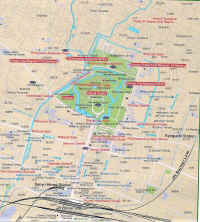
Map of Himeji City
|