|

SEPARATION OF POWERS
The constitution of Japan, which came into effect
in 1947, is based on the principles of popular sovereignty, respect for
fundamental human rights, and the advocacy of peace. Japan's political
system is one of constitutional democracy. In accordance with the
principle of "separation of powers," the activities of the national
government are formally divided into legislative, judicial, and executive
organs.
The Emperor is "the symbol of the State and
unity of the people." The Emperor appoints the Prime Minister and
Chief Judge of the Supreme Court as designated by the Diets, and performs
"only such acts in matters of state" as provided for in the
Constitution along with the advice and approval of the Cabinet, such as
promulgation of amendments of the constitution, laws, cabinet orders and
treaties, convocation of the Diets, dissolution of the House of Representatives,
and so forth.
Back to Top
The Constitution of Japan proclaims a system of
representative democracy in which the Diet is "the highest organ of state
power." It is formally specified that the Diet, as the core of
Japan's system of governance, takes precedence over the government's executive
branch. The designation of the Prime Minister, who heads the executive
branch, is done by resolution of the Diet. Japan practices a system of
parliamentary Cabinet by which the Prime Minister appoints the majority of the
Cabinet members from among members of the Diet. The Cabinet thus works in
solidarity with the Diet and is responsible to it. In this respect, the
system is similar to that of Great Britain, but different from that of the
United States, where the three branches of government are theoretically on a
level of perfect equality.
The Diet is divided into two chambers: The lower
chamber, or the House of Representatives, and the upper chamber, or the House of
Councillors. The House of Representatives may introduce "no
confidence motions" with respect to the Cabinet. The Cabinet, on the
other hand, is able to dissolve the House of Representatives. It also has
the authority to designate the Chief Judge and appoint the other judges of the
Supreme Court. It is the Supreme Court that determines the
constitutionality of any law of official act. The constitution authorizes
the Diet to "set up an impeachment court from among the members of both
Houses in order to try any judges against whom removal proceedings have been
instituted."
Back to Top
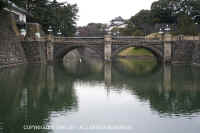
THE EMPEROR
Under the Constitution of Japan, the emperor is the
symbol of the state, but he has no powers related to government. He
performs only those acts that are stipulated in the Constitution.
Emperor Akihoto was born in Tokyo on December 23,
1933, the first son of Emperor Hirohito and Empress Nagako. Then Crown
Prince Akihito married Michiko Shoda, the eldest daughter of the president of a
major flour manufacturing company, in April 1959. He acceded to the throne
on January 7, 1989, upon the death of his father, the late Emperor Hirohito
(posthumously named Emperor Showa), who was the longest reigning and
longest-living emperor in Japanese history. He passed away at the age of
87 after reigning for 62 years. Emperor Akihito is noted for his taxonomic
studies of fish. He has published a number of academic papers on gobiid
fish and is coauthor of a 1987 book on Japan's freshwater fish species.
Back to Top
Emperor Akihito and Empress Michiko have three
children: Crown Prince Naruhito, born on February 23, 1960; Prince Fumihito,
born on November 30, 1965; and Princess Sayako, brown on April 18, 1969.
Crown Prince Naruhito studied at Oxford University in England from 1983-1985,
and Prince Fumihito did likewise from 1988 to 1990. In June 1993, Crown
Prince Naruhito married Masako Owada, the eldest daughter of an administrative
vice-minister for foreign affairs and herself a member of the diplomatic corps
until the engagement was announced. Prince Fumihito married Kiko Kawashima
in June 1990, upon which he received the family name Akishino. A daughter,
Princess Mako, was born in October 1991; a second daughter, Princess Kako, was
born in December 1994.
Back to Top
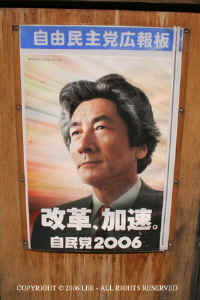
POLITICAL PARTIES
The first political party to emerge in Japan was
the Aikoku Koto (Public Party of the Patriots), formed in 1874 under the
leadership of Taisuke Itagaki. The party presented a written petition
Back to Top
Other Related
Sites...
Information provided by the
Japanese Embass
|