|
Japanese
Architecture
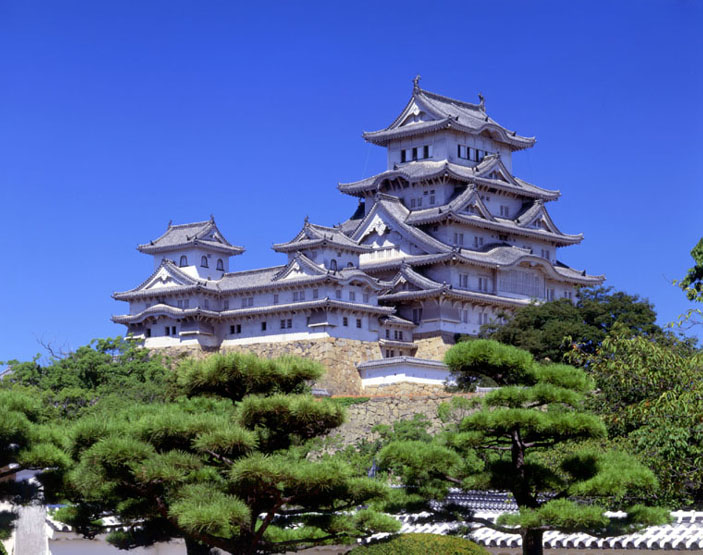
Himeji
Castle
The
introduction of Buddhism into Japan in 538, also brought many architects from
the Korean peninsula with new techniques reflecting the Chinese (Northern Wei)
style of Buddhist architecture. Horyuji, a temple in Nara whose main hall
and pagoda date back to the Asuka period, was built in this style. Architecture
during the Nara period (710-794) was influenced by the Tang style which was
characterized by stable and balanced proportions and by an emphasis on structure
over ornamentation. The lecture hall of Toshodaiji, a temple in Nara, is
one of the finest representations of this style.
Domestic
architecture during the Muromachi period (1333-1573) witnessed the perfection of
the shoin-zukuri style, which is the precursor of the style of the
present-day Japanese house with tatami mats covering floors. From about
this time, with the completion of the shoin-zukuri style of residential
architecture, ikebana and the tea ceremony became popular, and still are to this
day.
More...
Back to Top
The
Momoyama period (1573-1603) brought about an increased awareness of culture,
through merchants who amassed wealth through overseas trade. An example is
the popularization and spread of the tea ceremony, which led to the development
of sukiya-zukuri, an architectural style exclusively for tea ceremony
purposes. This style is still used in architecture today.
Western
styles of architecture have spread rapidly since the Meiji period and today,
Japanese cities are dominated by forests of modern skyscrapers, some of them
employing traditional Japanese design here and there.
Architecture
has evolved quite a bit since the heavy Chinese influence early in Japan's
history. It has changed to suit the needs of the people and with the ever
increasing influences brought in. Buddhism had a tremendous influence that
is still present today by way of temples. It eventually affected the nature of
Shino worship as well as taking elements from Buddhist architecture and
incorporating it.
More
recently, Western influences have changed the way Japanese use raw
materials. More stone and bricks are used in construction while still
attempting to keep the aspect of traditional Japanese architecture. Even
with all the changes, the traditional Japanese style hasn't completely
disappeared. A minor example of this is that the custom of removing one's shoes
before entering a house is still commonly practiced.
More...
Back to Top
|