|
SEPARATION
OF POWERS
The
constitution of Japan, which came into effect in
1947, is based on the principles of popular
sovereignty, respect for fundamental human
rights, and the advocacy of peace. Japan's
political system is one of constitutional
democracy. In accordance with the
principle of "separation of powers,"
the activities of the national government are
formally divided into legislative, judicial, and
executive organs.
The
Emperor is "the symbol of the State and
unity of the people." The Emperor
appoints the Prime Minister and Chief Judge of
the Supreme Court as designated by the Diets,
and performs "only such acts in matters of
state" as provided for in the Constitution
along with the advice and approval of the
Cabinet, such as promulgation of amendments of
the constitution, laws, cabinet orders and
treaties, convocation of the Diets, dissolution
of the House of Representatives, and so forth.
Back
to Top
The
Constitution of Japan proclaims a system of
representative democracy in which the Diet is
"the highest organ of state power."
It is formally specified that the Diet, as the
core of Japan's system of governance, takes
precedence over the government's executive
branch. The designation of the Prime
Minister, who heads the executive branch, is
done by resolution of the Diet. Japan
practices a system of parliamentary Cabinet by
which the Prime Minister appoints the majority
of the Cabinet members from among members of the
Diet. The Cabinet thus works in solidarity
with the Diet and is responsible to it. In
this respect, the system is similar to that of
Great Britain, but different from that of the
United States, where the three branches of
government are theoretically on a level of
perfect equality.
The
Diet is divided into two chambers: The lower
chamber, or the House of Representatives, and
the upper chamber, or the House of Councillors.
The House of Representatives may introduce
"no confidence motions" with respect
to the Cabinet. The Cabinet, on the other
hand, is able to dissolve the House of
Representatives. It also has the authority
to designate the Chief Judge and appoint the
other judges of the Supreme Court. It is
the Supreme Court that determines the
constitutionality of any law of official act.
The constitution authorizes the Diet to
"set up an impeachment court from among the
members of both Houses in order to try any
judges against whom removal proceedings have
been instituted."
Back
to Top
THE
EMPEROR
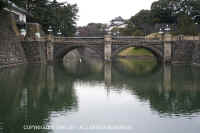
Under
the Constitution of Japan, the emperor is the
symbol of the state, but he has no powers
related to government. He performs only
those acts that are stipulated in the
Constitution.
Emperor
Akihoto was born in Tokyo on December 23, 1933,
the first son of Emperor Hirohito and Empress
Nagako. Then Crown Prince Akihito married
Michiko Shoda, the eldest daughter of the
president of a major flour manufacturing
company, in April 1959. He acceded to the
throne on January 7, 1989, upon the death of his
father, the late Emperor Hirohito (posthumously
named Emperor Showa), who was the longest
reigning and longest-living emperor in Japanese
history. He passed away at the age of 87
after reigning for 62 years. Emperor
Akihito is noted for his taxonomic studies of
fish. He has published a number of
academic papers on gobiid fish and is coauthor
of a 1987 book on Japan's freshwater fish
species.
Back
to Top
Emperor
Akihito and Empress Michiko have three children:
Crown Prince Naruhito, born on February 23,
1960; Prince Fumihito, born on November 30,
1965; and Princess Sayako, brown on April 18,
1969. Crown Prince Naruhito studied at
Oxford University in England from 1983-1985, and
Prince Fumihito did likewise from 1988 to 1990.
In June 1993, Crown Prince Naruhito married
Masako Owada, the eldest daughter of an
administrative vice-minister for foreign affairs
and herself a member of the diplomatic corps
until the engagement was announced. Prince
Fumihito married Kiko Kawashima in June 1990,
upon which he received the family name Akishino.
A daughter, Princess Mako, was born in October
1991; a second daughter, Princess Kako, was born
in December 1994.
Back
to Top
POLITICAL
PARTIES
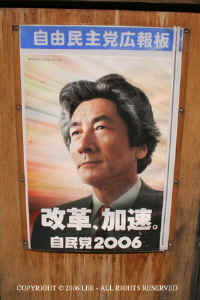
The
first political party to emerge in Japan was the
Aikoku Koto (Public Party of the Patriots),
formed in 1874 under the leadership of Taisuke
Itagaki. The party presented a written
petition
|
Country name:
|
|
conventional long
form: none
conventional short
form: Japan
local long form: Nihon-koku/Nippon-koku
local short form: Nihon/Nippon
|
|
|
Government type:
|
|
a parliamentary
government with a constitutional
monarchy
|
|
|
Capital:
|
|
name: Tokyo
geographic
coordinates: 35
41 N, 139 45 E
time difference: UTC+9
(14 hours ahead of Washington, DC during
Standard Time)
|
|
|
Administrative
divisions:
|
|
47 prefectures;
Aichi, Akita, Aomori, Chiba, Ehime,
Fukui, Fukuoka, Fukushima, Gifu, Gunma,
Hiroshima, Hokkaido, Hyogo, Ibaraki,
Ishikawa, Iwate, Kagawa, Kagoshima,
Kanagawa, Kochi, Kumamoto, Kyoto, Mie,
Miyagi, Miyazaki, Nagano, Nagasaki,
Nara, Niigata, Oita, Okayama, Okinawa,
Osaka, Saga, Saitama, Shiga, Shimane,
Shizuoka, Tochigi, Tokushima, Tokyo,
Tottori, Toyama, Wakayama, Yamagata,
Yamaguchi, Yamanashi
|
|
|
Independence:
|
|
3 May 1947 (current
constitution adopted as amendment to
Meiji Constitution); notable earlier
dates: 660 B.C. (traditional date of the
founding of the nation by Emperor JIMMU);
29 November 1890 (Meiji Constitution
provides for constitutional monarchy)
|
|
|
National holiday:
|
|
Birthday of Emperor
AKIHITO, 23 December (1933)
|
|
|
Constitution:
|
|
3 May 1947
|
|
|
Legal system:
|
|
modeled after
European civil law systems with
English-American influence; judicial
review of legislative acts in the
Supreme Court; accepts compulsory ICJ
jurisdiction with reservations
|
|
|
Suffrage:
|
|
20 years of age;
universal
|
|
|
Executive branch:
|
|
chief of state: Emperor
AKIHITO (since 7 January 1989)
head of government: Prime
Minister Naoto KAN (since 8 June 2010)
cabinet: Cabinet
is appointed by the prime minister
elections: Diet
designates the prime minister;
constitution requires that the prime
minister commands parliamentary
majority; following legislative
elections, the leader of majority party
or leader of majority coalition in House
of Representatives usually becomes prime
minister; the monarchy is hereditary
|
|
|
Legislative branch:
|
|
bicameral Diet or
Kokkai consists of the House of
Councillors or Sangi-in (242 seats -
members elected for fixed six-year
terms; half reelected every three years;
146 members in multi-seat constituencies
and 96 by proportional representation)
and the House of Representatives or
Shugi-in (480 seats - members elected
for maximum four-year terms; 300 in
single-seat constituencies; 180 members
by proportional representation in 11
regional blocs); the prime minister has
the right to dissolve the House of
Representatives at any time with the
concurrence of the cabinet
elections: House
of Councillors - last held on 11 July
2010 (next to be held in July 2013);
House of Representatives - last held on
30 August 2009 (next to be held by
August 2013)
election results: House
of Councillors - percent of vote by
party - DPJ 31.6%, LDP 24.1%, YP 13.6%,
NK 13.1%, JCP 6.1%, SDP 3.8%, others
7.7%; seats by party - DPJ 106, LDP 84,
NK 19, YP 11, JCP 6, SDP 4, others 12
House of
Representatives - percent of vote by
party (by proportional representation) -
DPJ 42.4%, LDP 26.7%, NK 11.5%, JCP
7.0%, SDP 4.3%, others 8.1%; seats by
party - DPJ 308, LDP 119, NK 21, JCP 9,
SDP 7, others 16 (2009)
|
|
|
Judicial branch:
|
|
Supreme Court (chief
justice is appointed by the monarch
after designation by the cabinet; all
other justices are appointed by the
cabinet)
|
|
|
Political parties
and leaders:
|
|
Democratic Party of
Japan or DPJ [Naoto KAN]; Japan
Communist Party or JCP [Kazuo SHII];
Liberal Democratic Party or LDP [Sadakazu
TANIGAKI]; New Komeito or NK [Natsuo
YAMAGUCHI]; People's New Party or PNP [Shizuka
KAMEI]; Social Democratic Party or SDP
[Mizuho FUKUSHIMA]; Your Party or YP
[Yoshimi WATANABE]
|
|
|
Political pressure
groups and leaders:
|
|
other: business
groups; trade unions
|
|
|
International
organization participation:
|
|
ADB, AfDB (nonregional
member), APEC, ARF, ASEAN (dialogue
partner), Australia Group, BIS, CE
(observer), CERN (observer), CICA
(observer), CP, EAS, EBRD, FAO, FATF,
G-20, G-5, G-7, G-8, G-10, IADB, IAEA,
IBRD, ICAO, ICC, ICCt, ICRM, IDA, IEA,
IFAD, IFC, IFRCS, IHO, ILO, IMF, IMO,
IMSO, Interpol, IOC, IOM, IPU, ISO, ITSO,
ITU, ITUC, LAIA (observer), MIGA, NEA,
NSG, OAS (observer), OECD, OPCW, OSCE
(partner), Paris Club, PCA, PIF
(partner), SAARC (observer), SECI
(observer), UN, UN Security Council
(temporary), UNCTAD, UNDOF, UNESCO,
UNHCR, UNIDO, UNMIS, UNRWA, UNWTO, UPU,
WCO, WFTU, WHO, WIPO, WMO, WTO, ZC
|
|
|
Diplomatic
representation in the US:
|
|
chief of mission: Ambassador
Ichiro FUJISAKI
chancery: 2520
Massachusetts Avenue NW, Washington, DC
20008
telephone: [1]
(202) 238-6700
FAX: [1]
(202) 328-2187
consulate(s) general:
Atlanta,
Boston, Chicago, Denver, Detroit, Agana
(Guam), Honolulu, Houston, Los Angeles,
Miami, New York, Portland (Oregon), San
Francisco, Seattle
consulate(s): Anchorage,
Nashville
|
|
|
Diplomatic
representation from the US:
|
|
chief of mission: Ambassador
John V. ROOS
embassy: 1-10-5
Akasaka, Minato-ku, Tokyo 107-8420
mailing address: Unit
9800, Box 300, APO AP 96303-0300
telephone: [81]
(03) 3224-5000
FAX: [81]
(03) 3505-1862
consulate(s) general:
Naha
(Okinawa), Osaka-Kobe, Sapporo
consulate(s): Fukuoka,
Nagoya
|
|
|
Flag description:
|
|
white with a large
red disk (representing the sun without
rays) in the center
|
|
|
National anthem:
|
|
name: "Kimigayo"
(The Emperor"s Reign)
lyrics/music: unknown/Hiromori
HAYASHI
note: adopted
1999; in use as unofficial national
anthem since 1883; oldest anthem lyrics
in the world, dating to the 10th century
or earlier; there is some opposition to
the anthem because of its association
with militarism and worship of the
emperor
|
Back
to Top
|