|
Languages:
|
|
Japanese
|
|
|
Literacy:
|
|
definition: age
15 and over can read and write
total
population: 99%
male: 99%
female: 99%
(2002)
|
|
|
School
life expectancy (primary to tertiary education):
|
|
total: 15
years
male: 15
years
female: 15
years (2008)
|
|
|
Education
expenditures:
|
|
3.7% of GDP
(2007)
country
comparison to the world: 126 |
As
of May 1995 approximately 23.7 million people were
receiving education in Japan from the kindergarten to the
university level. This figure includes students
attending so-called miscellaneous schools, which primarily
provide vocational and practical training. About
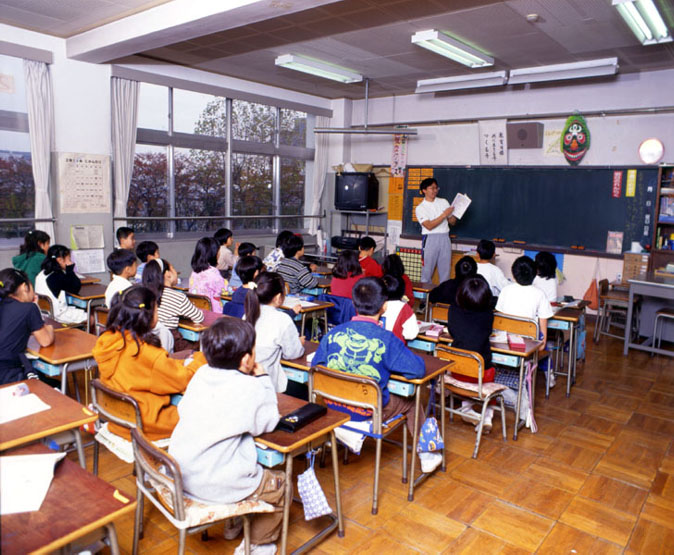
12.9 million were receiving compulsory education at
elementary schools (six years starting at the age of six)
and junior high schools (three years).
Of
the rest, 1,808,432 were attending kindergartens,
4,724,945 senior high schools (three years), 2,546,649
universities (four years) and graduate schools.
The
school attendance rate for the nine years of compulsory
education 99.99%. In 1979 education of mentally and
physically handicapped and sickly children also became
compulsory. As a result, children until then exempt
from or allowed to delay their schooling, such as
bedridden children, were registered at schools and began
receiving education at their homes from visiting teachers.
More... Back
to Top
The
rate of advancement from compulsory education to senior
high schools was 96.7% in 1995. Meanwhile, the rate
of advancement to universities and junior colleges reached
45.5%.
Japan's
education system played a central part in enabling the
country to meet the challenges presented by the need to
quickly absorb Western ideas, science and technology, and
it was also a key part in Japan's recovery and rapid
economic growth in the decades following the end of World
War II.
After
WWII, the Fundamental Law on Education and the School
Education law were enacted in 1947 under the direction of
the Occupation forces. The latter law defined the
system that is still in use today: six years of elementary
school, three years of junior high school, three years of
high school, two or four years of university.
Elementary and junior high school attendance is
compulsory.
Education
prior to elementary school is provided at kindergartens
and day-care centers. Public and private day-care
centers will take children from under age one on up to 5
years old. The programs for those children ages 3-5
resembles those at kindergartens.
The educational approach at kindergartens various greatly
from unstructured environments that emphasize play to
highly structured environments that are focused on having
the child pass the entrance exam at a private elementary
school.
More... Back
to Top
Information
provided by the Japanese Embassy |