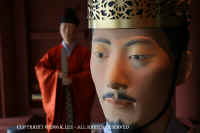
Ancient
Japanese Museum
THE
RISE AND DIVERSITY OF VACATIONS
There
are certain times in Japan when holidays appear one after
another, such as Golden Week, from the end of April to the
beginning of May. Other full scale holidays are at
the end of the year (New Year's) and the middle of August
(Bon festival).
Vacations
are concentrated during these three periods. As a
result, 3 times in the year, the throng of people on
transportation facilities and roads returning home to
visit parents and coming back again, unfailingly becomes
an issue. Travel abroad during this period reaches a
peak at international airports such as New Tokyo
International Airport (Narita), which is invariably
congested with people.
There
are businesses adopting flexible holidays to avoid the
crowd. Taking annual vacations has become an
accepted company policy even taking days off has now
become easier. An amendment of the Labor Standard
Law, carried out in April 1997, implemented a 40-hour
week. Consequently, the era of a 5-day work week has
finally gained ground.
Based
on the activities and polled opinions of those 15 years
and older, the shorter the holiday, the more one indulges
in pastimes like gambling. When the holiday is 2 to
3 days long, gambling decreases and activities such as
driving, enjoying the outdoors and outdoor sports
increase. When the holiday stretches to 3 or more
days, domestic and international travel shows a sharp
increase, as well as activities in the areas of
self-enrichment including family communication, reading
and studying.
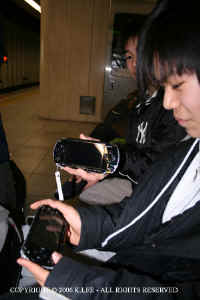
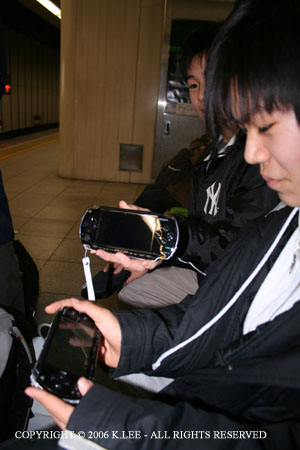
Boys
with Playstation
ELECTRO-LEISURE
The
unique sense of creativity of the Japanese and their
penchant for electronic technology have spawned a new way
of enjoying leisure in an area called electro-leisure,
such as karaoke, animation, computer game software and
pachinko. With the shift to economy travel,
these types of leisure are expected to become even more
popular.
Pachinko,
or pinball, is played on a vertical glass-covered machine
that has a number of holes in the panel. The object
of the game is to get the ball into a lucky hole, which
results in more balls being emitted by the machine.
Collected balls can be exchanged for prizes. Pachinko
was formerly an entertainment for a select few in Japan,
but is now enjoyed by all types of people, even young
women. It is considered to be the king of amusement
for the masses and the numbers of those who become
completely preoccupied with and dependent upon pachinko
have been on the rise.
Karaoke
is a Japanese invention that has been sweeping the world.
It is a system where musical accompaniment to a song is
prerecorded on a compact or laser disc. A song is
selected and played. One sings into a microphone
equipped with echo effects to the selected song. The
range and tempo can be altered at will. Karaoke
equipment run by inserting coin was made in the early
1970's. Songs can now be freely selected by remote
control. There are even karaoke
communications equipment that are connected to the
telephone.
TRADITIONAL
LEISURE
Horse
racing has become one of the gambling favorites to
flourish on a par with pachinko, which is
unprecedented in the world. The betting tickets sold
by the Japan Racing Association (JRA), a special body
under supervision of the Ministry of Agriculture,
Forestry, and Fisheries, have been marking profits yearly.
The only year of decline was in 1995, the year of the
Hanshin-Awaji earthquake in Kobe, but it rebounded the
following year to mark a plus growth of 3.98 trillion yen
(US $36.6 billion). The rate of increase has again
slowed again.
A
single horse racing event by the JRA runs for 8 days at 10
racing tracks throughout Japan, for a total of 36 times
for 288 days. In addition, local horse racing,
carried out by the various local municipalities are held
at 30 regional racing tracks throughout Japan.
Go
and shogi are representative of Japanese
traditional indoor games. Go is played by 2
players. Black and white stones are alternately
placed on a board with the objective of capturing the
opponent's stones and covering the board with one's own
stone color.
Shogi
resembles chess somewhat; the 2 players face each other.
The pieces are moved alternately, the objective being to
capture the opponent's king. Shogi originated
in India and made its way to China. The difference
in the Japanese version is that a captured piece can
be used as one's own. With the diversity of TV
games, amusement and leisure, the number of those who play
go and shogi has decreased to less than 10%.
Although
many Japanese enjoy traveling overseas, karaoke,
and pachinko in their free time, they also enjoy
traditional pastimes. Cherry blossom flower viewing
is an all-time favorite in the spring, as the blossoms
unfold from south to north. Many also pursue the
scarlet-tinged leaves in the autumn.
Back
to Top
Information
provided by the Japanese Embassy
|