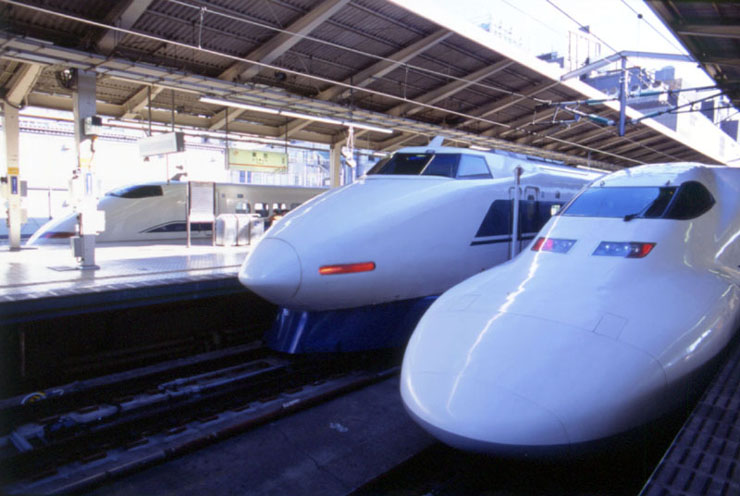
In
1872, passenger service began with a steam locomotive
that linked Shimbashi station, in Tokyo, to the nearby
city of Yokohama. This set the stage for a
nationwide rail network. After 17 years, a railway
system was established that linked the main cities along
the old Tokaido (Eastern Sea Route) so that a person
could travel from Tokyo to Osaka by train. Now,
along with the development of automobile and air
transportation, important railway services have
gradually shifted to long-distance intercity transport,
such as the Shinkansen and commuter lines.
Commuter lines carry people from their homes in the
suburbs back and forth to work.
Of
the total 1,142,000 km of roads in Japan, 73% is paved.
Construction of expressways (toll roads) began in the
1960's and has faced many challenges: the nature of the
terrain, high concentration of factories and housing,
high land prices along the routes, and added
reinforcement needed to withstand earthquakes.
Construction costs are the world's highest and
therefore, the tolls are also high.
Back
to Top
After
WWII and until 1951, the Japanese government was
deprived of its authority to permit passenger airlines
by SCAP (Supreme Commander of the Allied Powers).
Because of this, international and domestic airlines
didn't start until 1953.
The
beginnings of a national railway system started in 1872
with the connection by steam locomotive of Tokyo to
Yokohama. Seventeen years after this
accomplishment there was a link from Tokyo to Osaka by
train, a trip that took 20 hours to complete. With
the introduction of diesel and electric trains, time was
shortened considerable to a mere 6 1/2 hours.
Later on the bullet train "Shinkansen" reduced
it even more by completing it in under 3 hours.
Not
stopping with the mainland, a connection was made by
rail linking Honshu to the northern island of Hokkaido.
This was accomplished by building the world's longest
undersea tunnel undersea tunnel, the Seikan Tunnel.
Honshu was also linked to Shikoku Island that same year
with the Seto Ohashi Bridge which was built over the
Inland Sea.
Transportation
by rail has decreased with the invention of cars and
airplanes, thus a change to long-distance intercity
transportation and commuter lines. Commuter lines
are rails that take people to and from work in the
suburbs. Since the cost of living is tremendous in
the city, people are moving to the suburbs in order to
find acceptable housing that is a reasonable cost.
The price they pay is more time spent waiting while
commuting to work and back.
In
Japan, there are nine cities that have subway systems
with the first one starting in 1927. Many subways
also link with commuter lines to reach out to the
suburbs as well. Japan is also looking into linking the
publi and private transportation systems. Further
rail developments include a light rail transit (LRT)
which was initiated in Kumamoto in 1997, this is the
first one operated in Japan.
Back
to Top
MOTOR
VEHICLES AND GROUND TRANSPORTATION
In
1899, the first automobile was brought into Japan and by
1902 they were producing their own. Although the
Japanese manufactured cars, the majority were used
commercially or for public transportation. Private
ownership didn't really get popular until the 1960's.
Three reasons made this possible: rapid financial growth
brought on by economic development; smaller, more fuel
efficient cars targeting private owners; road
improvements. In 36 years, from 1960 to 1996, car
ownership increased from 1.5 million to over 72 million.
Now it is common for families to have two cars and truck
use has increased in the delivery and commercial area.
Toll
road construction began in the 60's and the first one
completed in 1965 linked Nagoya to Kobe. This road
was named the Meishin Expressway which was rapidly
followed by the Tomei Expressway which added Tokyo to
the connection. These roads, and the many other
expressways linking suburbs to the downtown areas, are
managed by the Japan Highway Public Corporation.
The JHPC doesn't have an easy job because there are many
factors to take into account when constructing roads in
Japan. The terrain is not conducive to easy road
construction, high factory and housing concentration
-which causes heavy traffic in those areas, expensive
land, and certainly not to be forgotten, earthquakes
-which require added reinforcement in the roads.
Because of these factors, Japan's construction costs are
the highest in the world and therefore, the toll roads
reflect that in their usage fees.
Not
surprisingly, Japan's metropolitan areas are areas of
congestion with the high traffic volume and traffic
safety has been a problem since the explosion of private
ownership in the 60's. Along with this congestion
comes air pollution from the automobiles' exhaust.
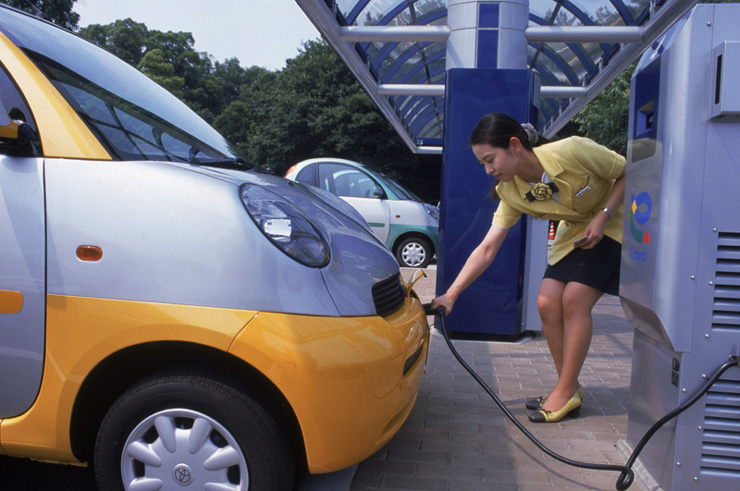
Japanese manufacturers are working on developing hybrid
cars which are expected to reduce pollution.
Back
to Top
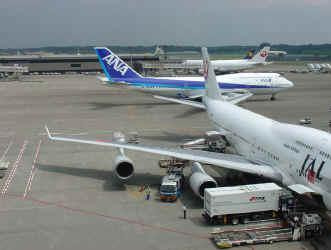
AIR
TRANSPORTATION
International
and domestic airlines didn't get started in Japan until
1953. This was due to the fact that after World
War II, the Japanese weren't allowed to have passenger
airlines by order of the Supreme Commander of the Allied
Powers (SCAP).
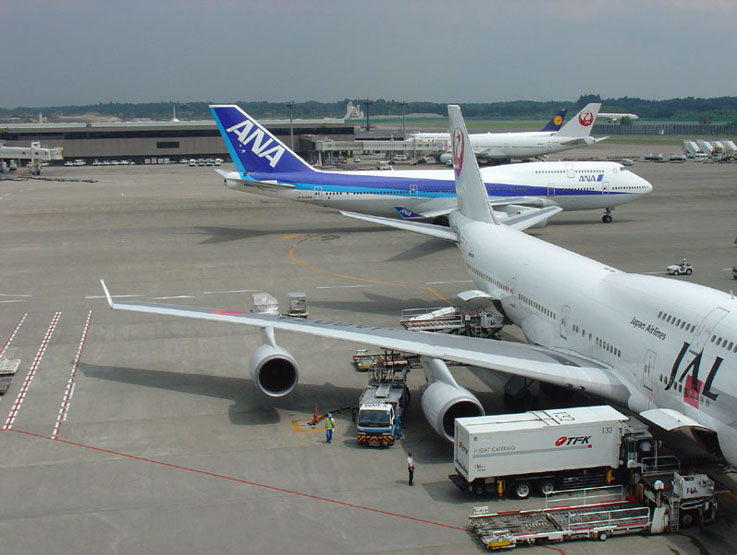
Haneda,
Tokyo International Airport, was Japan's first
commercial airport and it first opened in 1931.
Until the opening of the New Tokyo International Airport
in 1978, it was both a domestic and international
airport. With the opening of the New Tokyo
International Airport, Narita Airport, it is
about 65 km outside Tokyo. 38 countries, as of
1997, with a total of 50 airlines used the airport.
It is Japan's largest airport and handles over 25
million passengers per year and a little over 1.5
million metric tons of air freight. These
incredible numbers put it at sixth in the world for
passengers and first in the world for freight.
Kansai
International Airport, which opened in 1994 handles most
of the domestic flights and all of the international
flights to the Kansai regions. This airport, which
replaced the Osaka International Airport, Itami
Airport, is actually on an artificial island and
operates 24 hours a day.