AsianInfo.org
supports
I.C.E.Y. - H.O.P.E. (non-profit
org) (International
Cooperation of Environmental Youth - Helping Our Polluted Earth)
Any advertisement you view helps save the environment!
Thanks!
conventional
long form: Socialist
Republic of Vietnam
conventional
short form: Vietnam
local
long form: Cong
Hoa Xa Hoi Chu Nghia Viet Nam
local
short form: Viet
Nam
abbreviation:
SRV
Government
type:
Communist
state
Capital:
name: Hanoi
(Ha Noi)
geographic
coordinates: 21
02 N, 105 51 E
time
difference: UTC+7
(12 hours ahead of Washington, DC during
Standard Time)
Administrative
divisions:
58 provinces (tinh,
singular and plural) and 5 municipalities (thanh pho,
singular and plural)
provinces: An
Giang, Bac Giang, Bac Kan, Bac Lieu, Bac Ninh, Ba
Ria-Vung Tau, Ben Tre, Binh Dinh, Binh Duong, Binh Phuoc,
Binh Thuan, Ca Mau, Cao Bang, Dac Lak, Dac Nong, Dien
Bien, Dong Nai, Dong Thap, Gia Lai, Ha Giang, Ha Nam, Ha
Tinh, Hai Duong, Hau Giang, Hoa Binh, Hung Yen, Khanh
Hoa, Kien Giang, Kon Tum, Lai Chau, Lam Dong, Lang Son,
Lao Cai, Long An, Nam Dinh, Nghe An, Ninh Binh, Ninh
Thuan, Phu Tho, Phu Yen, Quang Binh, Quang Nam, Quang
Ngai, Quang Ninh, Quang Tri, Soc Trang, Son La, Tay Ninh,
Thai Binh, Thai Nguyen, Thanh Hoa, Thua Thien-Hue, Tien
Giang, Tra Vinh, Tuyen Quang, Vinh Long, Vinh Phuc, Yen
Bai
municipalities: Can
Tho, Da Nang, Ha Noi, Hai Phong, Ho Chi Minh City
Independence:
2 September 1945
(from France)
National holiday:
Independence Day, 2
September (1945)
Constitution:
15 April 1992
Legal system:
based on communist
legal theory and French civil law system; has not
accepted compulsory ICJ jurisdiction
Suffrage:
18 years of age;
universal
Executive branch:
chief of state: President
Nguyen Minh TRIET (since 27 June 2006); Vice President
Nguyen Thi DOAN (since 25 July 2007)
head of government: Prime
Minister Nguyen Tan DUNG (since 27 June 2006); Permanent
Deputy Prime Minister Nguyen Sinh HUNG (since 28 June
2006), Deputy Prime Minister Hoang Trung HAI (since 2
August 2007), Deputy Prime Minister Nguyen Thien NHAN
(since 2 August 2007), Deputy Prime Minister Pham Gia
KHIEM (since 28 June 2006), and Deputy Prime Minister
Truong Vinh TRONG (since 28 June 2006)
cabinet: Cabinet
appointed by president based on proposal of prime
minister and confirmed by National Assembly
elections: president
elected by the National Assembly from among its members
for five-year term; last election held 27 June 2006
(next to be held in January 2011); prime minister
appointed by the president from among the members of the
National Assembly; deputy prime ministers appointed by
the prime minister; appointment of prime minister and
deputy prime ministers confirmed by National Assembly
election results: Nguyen
Minh TRIET elected president; percent of National
Assembly vote - 94%; Nguyen Tan DUNG elected prime
minister; percent of National Assembly vote - 92%
Legislative branch:
unicameral National
Assembly or Quoc Hoi (493 seats; members elected by
popular vote to serve five-year terms)
elections: last
held on 20 May 2007 (next to be held in May 2012)
election results: percent
of vote by party - NA; seats by party - CPV 450,
non-party CPV-approved 42, self-nominated 1; note - 493
candidates were elected; CPV and non-party CPV-approved
delegates were members of the Vietnamese Fatherland
Front
Judicial branch:
Supreme People's
Court (chief justice is elected by the National Assembly
on the recommendation of the president for a five-year
term)
Political parties
and leaders:
Communist Party of
Vietnam or CPV [Nong Duc MANH]; other parties proscribed
Political pressure
groups and leaders:
8406 Bloc; Democratic
Party of Vietnam or DPV; People's Democratic Party
Vietnam or PDP-VN; Alliance for Democracy
note:these
groups advocate democracy but are not recognized by the
government
chancery: 1233
20th Street NW, Suite 400, Washington, DC 20036
telephone: [1]
(202) 861-0737
FAX: [1]
(202) 861-0917
consulate(s) general:
Houston,
New York, San Francisco
Diplomatic
representation from the US:
chief of mission: Ambassador
Michael W. MICHALAK
embassy: 7
Lang Ha Street, Ba Dinh District, Hanoi
mailing address: PSC
461, Box 400, FPO AP 96521-0002
telephone: [84]
(4) 3850-5000
FAX: [84]
(4) 3850-5010
consulate(s) general:
Ho
Chi Minh City
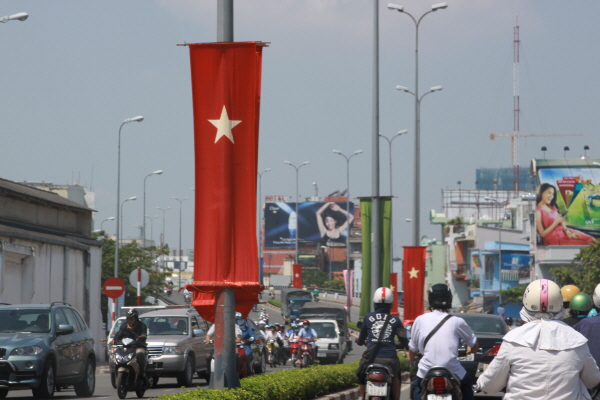
Flag description:
red field with a
large yellow five-pointed star in the center; red
symbolizes revolution and blood, the five-pointed star
represents the five elements of the populace - peasants,
workers, intellectuals, traders, and soldiers - that
unite to build socialism
National anthem:
name: "Tien
quan ca" (The Song of the Marching Troops)
lyrics/music: Nguyen
Van CAO
note:adopted
as the national anthem of the Democratic Republic of
Vietnam in 1945; it became the national anthem of the
unified Socialist Republic of Vietnam in 1976; although
it consists of two verses, only the first is used as the
official anthem
Vietnam's
government had been primarily based on Confucianism and institutions were based
on those in China. This changed after the French invasion with the emperor
being such in name only. When the country divided in 1954, the North
became Communist with the South following the example of Western
countries. With reunification in 1976, there were attempts to convert
South Vietnam to Communism. Although Communism has spread throughout the South,
it also caused a great exodus of people from Vietnam to other
countries.
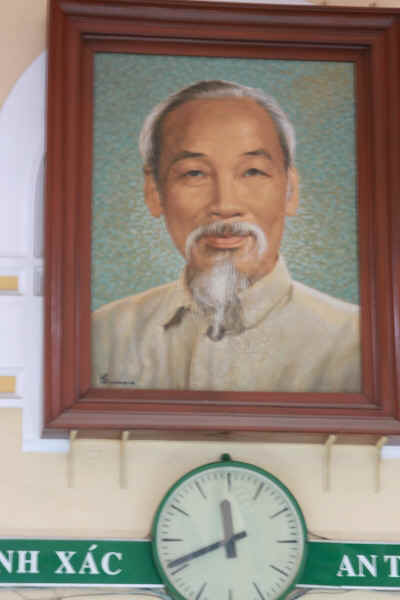
Ho Chi Min
In
1980, the constitution, similar to the Soviets' but with some democratic ideals
was promulgated. There were to be secret ballot elections, but overall the
Communist party would dictate what would be considered the best for everyone
overall. It was revised slightly in 1992 to show economic reforms that had
occurred in 1986 as well as decreasing the party's role in governing.
With this amendment, the
president is the head of the state and is elected to a five-year term by the
National Assembly. He has several advisors and assistants, among them the
National Defense and Security Council.
Vietnam's
political party is the Vietnamese Communist Party, with about 2.2 million
members and according to a 1992 constitutional amendment, the Communist Party is
"the force leading the State and society," thus giving it exclusive
power. Although the people want civil freedom, it doesn't mean they want
to copy the West's way of thinking, which is contrary to Confucian
traditions. The younger generation have influenced the Party and the
government's action, causing them to be more lenient in resolving economic
questions, because of their increased education and foreign experiences, with
another factor being Vietnamese who are returning home from around the
world.
AsianInfo.org
supports I.C.E.Y. -
H.O.P.E. (non-profit org) (International
Cooperation of Environmental Youth - Helping Our Polluted
Earth) Any advertisement you view helps save the
environment! Thanks!
Disclaimer:
AsianInfo.org
does not guarantee the complete accuracy of the information provided on
this site or links. Do your own research and get a professional's
opinion before adhering to advice or information contained herein.
Use of the information contained herein provided by AsianInfo.org and
any mistakes contained within are at the individual risk of the user.
(We
do not provide links to, or knowingly promote, any violent or pornographic
sites.)












 )
)