|
![bg-lgflag[1].gif (2561 bytes)](bg-lgflag1_small.gif)
Population
In 2010,
Bangladesh was estimated to be one of the ten most highly populated
countries with an estimated population of just under 160
million. This makes the population density of about 875 people
per sq km (2,267 people per sq mi) higher than other
countries. Most of the population is young with about 60
percent under the age of 25, with only about 3 percent over the age
of 65 (life expectancy is 61 years). Twenty percent of the
population was deemed to be urban in 1998, making Bangladesh's
population predominantly rural.
Bengalis make
up the majority of Bangladesh's population. They are
descendants from immigrant Indo-Aryans who came from the west and
intermarried with various Bengal groups. The minority in
Bangladesh is comprised of several groups, the Chakma and Mogh
(Mongoloid people who live in the Chittagong Hill Tracts District),
the Santal (migrants from India) and the Biharis (Muslims who came
from India). more....
Education
Education is not
compulsory, but is free for elementary students. Approximately
85 percent of the elementary school-aged children attend schools,
while secondary schools enroll less than 20 percent. This poor
attendance record is responsible for Bangladesh's literacy rate of
41 percent for people 15 years and older. The education system
in Bangladesh is similar to that begun by the British before 1947.
Over 500,000 students
attended colleges or universities in the years from 1989 to
1990. The largest (and oldest) university in Bangladesh is the
University of Dhaka which was established in 1921. Other
universities in Dhaka are Jahangirnagar University (1970) and the
Bangladesh University of Engineering and Technology (1962).
Two Bangladesh's colleges are Chittagong Polyechnic Institute (1962)
and Bangladesh College of Textile Technology (1950).
more....
History
Bangladesh was formed
in 1971, when the east Pakistan Province declared their independence
on March 26. They warred with the central Pakistan government,
and became financially separate later that year (December 16) with
financial help from India. Eventually other countries
recognized them and in 1974, they were admitted to the UN (United
Nations). It was at this time that Pakistan finally
acknowledged them and it was 1976 until China showed diplomatic
recognition.
In 1972, the new
government's prime minister, Sheikh Mujibur Rahman (Mujib), was
responsible for repairing the country that was destroyed by
war. This reparation included bringing order and structure to
the lawlessness that was sweeping the nation. There was much
political unrest that wasn't helped by nature. As a result of
severe flooding that destroyed grain crops, Bangladesh declared a
national state of emergency in 1974.
Mujib became
president in early 1975, but was killed later on that year in August
during a revolution without ever being able to calm down the
political situation. November 1975 brought about an overthrow
of Mujib's successor by the military. Instead, of Khandakar
Mushtaque Ahmed, they put in Abusadat Muhammad Sayem as Bangladesh's
president, who resigned the position in 1977.
more....
Sayem's successor,
General Ziaur Rahman was assassinated in 1981, just four years after
taking office, by another military coup. The vice president,
Abdus Sattar, took over office and was then elected to the office in
November. Once again, he was relieved of his duties when yet
another military takeover ensued. Lieutenant General Hossain
Mahammad Ershad was placed in power. His actions included
eliminating political parties and proposing the requirement for all
schools to teach the Korean and Arabic. This proposal brought
about rioting which brought political activities to a standstill
until later in the year (1983).
During most of this
time, Bangladesh was ruled under martial law. In 1986, martial
law was finally lifted and the constitution was reinstated. In
1988, Ershad resigned his position after much political conflict and
was promptly charged and put in jail on corruption and illegal
weapons charges.
General Ziaur
Rahman's widow was elected prime minister in 1991 and remained so
until 1996, when more....
Bangladesh
Travel
Guide
Geography
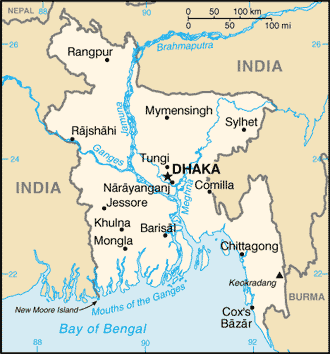
Covering about 580 km
of coastline along the Bay of Bengal is Bangladesh. A low
lying country, Bangladesh has trouble with flooding. This is
due to the number of rivers in the country and the fact that most of
the habitable areas are found on a delta, one formed by the
Brahmaputra and Ganges rivers. The floodwaters bring a lot of
rich, alluvial soil with them and houses in this area have to be
built on platforms or high embankments. These mud platforms
and embankments are made from mud that is taken out during the dryer
months (those without monsoons and the resulting flooding).
The holes or pits that are made by removing the mud are then filled
with water. This water is then used for drinking, bathing and
irrigation.
Only a small portion
of the country is considered hilly, the southeastern section.
In this area is found Bangladesh's highest peak, Mowdok Mual (3,291
ft/1.003 m). There are some insignificant hills found along the
north and eastern borders with India and there are two remnants of
alluvial terraces in the north central and northwestern portions of
Bangladesh. These are old terraces that are not nearly as
fertile as the floodplain surrounding them. These terraces
reach up to about 100 ft in height (30 m).
Climate
Warm temperatures are
found year-round throughout Bangladesh, with not much change,
although January seems to be the coolest month (66° F/19° C) while
May tends to be the warmest (84° F/ 29° C). Bangladesh has a
tropical monsoon climate, with most of the rainfall for the year
occurring during the monsoon period. The average precipitation
ranges from as much as 200 inches (5,080 mm) to as little as
55 inches (1,400 mm).
Monsoon season lasts
from May to October, with destructive cyclones occurring from April
to May and again from September to November. The cyclones
cause many deaths and a lot of destruction, particularly with the
surging waves that come along with them. One of the worst
natural disasters of the 20th century was caused by a cyclone that
struck Bangladesh in November 1970. In this storm about
500,000 people died, while in 1991, over 120,000 people died when a
cyclone struck the Ganges delta.
Flora/Fauna
The Bengal tiger is
found in the Sundarbans, while the Chittagong Hill Tracts are home
to elephant herds and leopards. Bangladesh is also home to other
animals such as the Bengal fox, jackal, vulture, swamp crocodile,
parakeet, mongoose and kingfisher. With 109 indigenous mammal
species, 684 types of birds, 119 varieties of reptiles, 200
different kinds of marine and freshwater fish as well as 19
different amphibians. A common mammal is the rhesus monkey
with other common animals being lemurs and gibbons.
There are very few
forests left in Bangladesh, only about an eighth of the country.
Exceptions are the Chittaogong Hill Tracts District (the hilliest
portion of Bangladesh), parts of the Madhupur Tract and the
Sundarbans. The Sundarbans is actually a mangrove swamp found
in the southwestern part of the country. The hilly areas of
Bangladesh have broadleaf evergreens, while the plains areas have
deciduous trees like acacia and banyan. Commercially, there
are several variety of trees - sundari, sal, gewa, garayans and in
the villages there are fruit trees such as jackfruit and mango.
Also found are numerous varieties of bamboo as well as areca (betel)
and date palm trees.
Language
Bangla, also known as
Bengali, is the official language of Bangladesh. It has it's
own script (from Sanskrit) and over 98 percent of the population
speaks this as their first language. The remaining population
speaks Urdu, mostly those who immigrated from India during the
1940's.
Religion
Almost 90 percent of
Bangladesh's population adhere to Islam, with most of this number
following the Sunni branch. Most of the remaining population
following Hinduism, with even fewer numbers of Buddhists,
Christians, and animists.
Bangladesh
Travel
Guide |






![bg-lgflag[1].gif (2561 bytes)](images/bg-lgflag[1].gif)


.svg)