AsianInfo.org
supports
I.C.E.Y. - H.O.P.E. (non-profit
org) (International
Cooperation of Environmental Youth - Helping Our Polluted Earth)
Any advertisement you view helps save the environment!
Thanks!
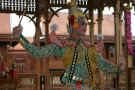
In ancient times, Korean dances were performed in religious
ceremonies, so they naturally took on some ritualistic characteristic although
they later grew into a form of entertainment.
Under the strong influence of Shamanism, Confucianism and
Buddhism, Korean dances became full-fledged artistic forms. These traditional
dances have dominant characteristics that have been kept alive until today.
By many accounts, primitive rites to the heavens were the
forbearers to dance as an artistic form. It was also influenced by folk dances
that were closely interwoven with daily life. In agrarian societies, communal
groups danced in impromptu fashion. As their lifestyle and thought were
inseparable from nature, folk dances were executed in spontaneous simple steps,
without employing much in the way of learned techniques or choreography.
One of the unique aspects of Korean dance is its streamlined
curvilinear movements. Angular movements were seldom used. Below is a brief
account of the distinctive characteristics of Korean dance.
First, unlike Western dancers, Korean dancers concentrate
energy in their torsos and move their shoulders and arms.
Second, there is great emphasis placed upon natural movements.
Korean dance tries to impact and express natural phenomena. For instance,
refined court dances such as Ch'unaengjon
(the Dance of the Spring Nightingale), Hakch'um (or Hangmu, Crane
Dance), or Sajach'um (Lion Dance) are all based upon depictions of
nature. Other dances inspired by natural things include the crane dance of the
Yangsan and Tongnae areas, the tortoise and stork dances seen in hot'iunch'um
(farmers' impromptu dances), the lion and monkey dances common in mask dance
dramas, dances of mystic animals in farmers' percussion music and dance
performances, and Nabich'um (Butterfly Dance) in a Buddhist ceremony.
Third, Korean dance emphasizes movement in the upper torso.
Most Western dancers basically follow the tempo of the heartbeat, while Korean
dancers follow the tempo of breathing.
Fourth, all movements are streamlined, curvilinear, without
isolated parts. If Western dancers accentuate angular, linear, and acrobatic
movements acquired by years of hard training, Korean dancers are not that
concerned with acquiring acrobatic traits.
Fifth, Korean dancers tends not to stick to any specific. A
dancer pursues master skills through the technique of "no technique."
He expresses his inner mood by dancing freely and spontaneously. When he pauses
for a moment, he suspends his breathing and maintains a static equilibrium. At
that moment, his suspended breathing itself becomes part of his movement.
In a broad sense, Korean dance seeks harmony. Like the rounded
shapes engaged together inside the great t'aeguk
circle, a dancer extends mellifluous lines from his chest to his extremities.
Attuning himself to his respiration, he lets his body undulate in the air, so
that it is hard to see where his movements begin and end, like the interlocking Cum
and yang symbols turning endlessly in a circle as one unity. Korean dance
seeks the aesthetics of "repose amidst motion." Interacting constantly
with the world, the dancer lets his bodily energy flare up and out and then
draws it back. Sungmu (Monk Dance) and Salp'urich'um
(in short Salp'uri, the Spirit-Cleansing dance or Exorcist) are
representative of this kind of dance. The long sleeves in the Sungmu and the long white silk scarves in the Salp'urich'um are the media with
which he expresses his inner mood. These two dances use the ki-gyong-gyol-hae
technique. That is, they unleash energy gradually at first, build up to dramatic
movements, halt at the climax, and then find release in repose.
Sixth, Korean dance is closely related to folk performances.
Traditionally, nong-ak, or performances by farmers' percussion bands, t'alch'um,
or mask dance dramas, Chishinbalki, or a lunar new year's celebration, Chuldarigi,
or tug of war as well as many other communal entertainments, express Korean's
dynamic optimistic spirit. Korean dances are largely classified into court,
folk, ritual, mask, shaman, and new dances. The special features of each
category are described below.
AsianInfo.org
supports I.C.E.Y. -
H.O.P.E. (non-profit org) (International
Cooperation of Environmental Youth - Helping Our Polluted
Earth) Any advertisement you view helps save the
environment! Thanks!
Disclaimer:
AsianInfo.org
does not guarantee the complete accuracy of the information provided on
this site or links. Do your own research and get a professional's
opinion before adhering to advice or information contained herein.
Use of the information contained herein provided by AsianInfo.org and
any mistakes contained within are at the individual risk of the user.
(We
do not provide links to, or knowingly promote, any violent or pornographic
sites.)