Over
90 percent of Thais follow Theravada Buddhism (a branch of
Hinayana Buddhism), and Buddhism is the most powerful force in the nation's
culture. In keeping with Buddhist teaching, we are a peace-loving nation.
Muslims are the second-biggest religious group with a following of almost 4
percent of the population, but there are also Christians, Hindus and other
faiths.
Thailand
protects religious liberty, even though the national religion is Buddhism and
most Thais are Buddhist. The people of Thailand are free to worship
and profess any religion as long as it doesn't go against "good
morals," public order or a person's civic duties. This is written in the
Constitution of the Kingdom of Thailand, Section 25, along with the statement
that "every person shall be protected from any act by the State, which is
derogatory to his right or detrimental to his due benefits on the ground of
professing a religion, ...denomination, ...tenet, ...or exercising a form of
worship in accordance with his belief which is different from that of others.
Over 90 percent of Thais follow
Theravada Buddhism (a branch of
Hinayana Buddhism), and Buddhism is the most
powerful force in the nation's culture. In keeping with Buddhist teaching, we
are a peace-loving nation. Muslims are the second-biggest religious group, but
there are also Christians, Hindus and other faiths. Tolerance is total, and
there is no history of religious conflict.
The Buddha was born Prince Siddhartha Gautama in India during the 6th century
BC. He gave up his riches to seek enlightenment, and later he taught others to
follow his path. Buddhism first came to Thailand a few centuries after Buddha's
death, and became a dominant force by the Sukhothai era. Statues of the Buddha
and murals depicting his previous ten lives can be found throughout Thailand.
Buddhism continues to exert a strong influence on daily life. Senior monks are
highly revered. In towns and villages the temple (wat) is the heart of social
and religious life. Each wat is a cluster of buildings including a meeting hall,
lodging for the monks, an ordination hall, and perhaps a library. The features
of each building, and the overall layout, are governed by established
principles. The architecture varies between historical periods.
The
Rocket Festival, perhaps the most thrilling of Thailand's regional celebrations. Large and elaborately decorated rockets are shot into the sky to
ensure good rains, and the accompanying revelry is very high-spirited. The Phi
Ta Khon Festival at Dan Sai and Loei in June centers on a parade of people
dressed as ghosts following a Buddha image through the streets of the town to
make Buddhist merit and call for rain. The beginning of the Buddhist "rains
retreat" in July sees a host of festivals. In Ubon Ratchathani's Candle
Festival, huge and intricately carved beeswax candles are paraded through
the town and presented to temples where they are lit throughout the rainy
season. The national holiday at the end of the "rains retreat" in
October is celebrated in particular style at Nakhon Phanom with the Illuminated
Boat Procession. Intricately fashioned model boats carrying single candles
are set adrift on the Mekong River at nightfall.
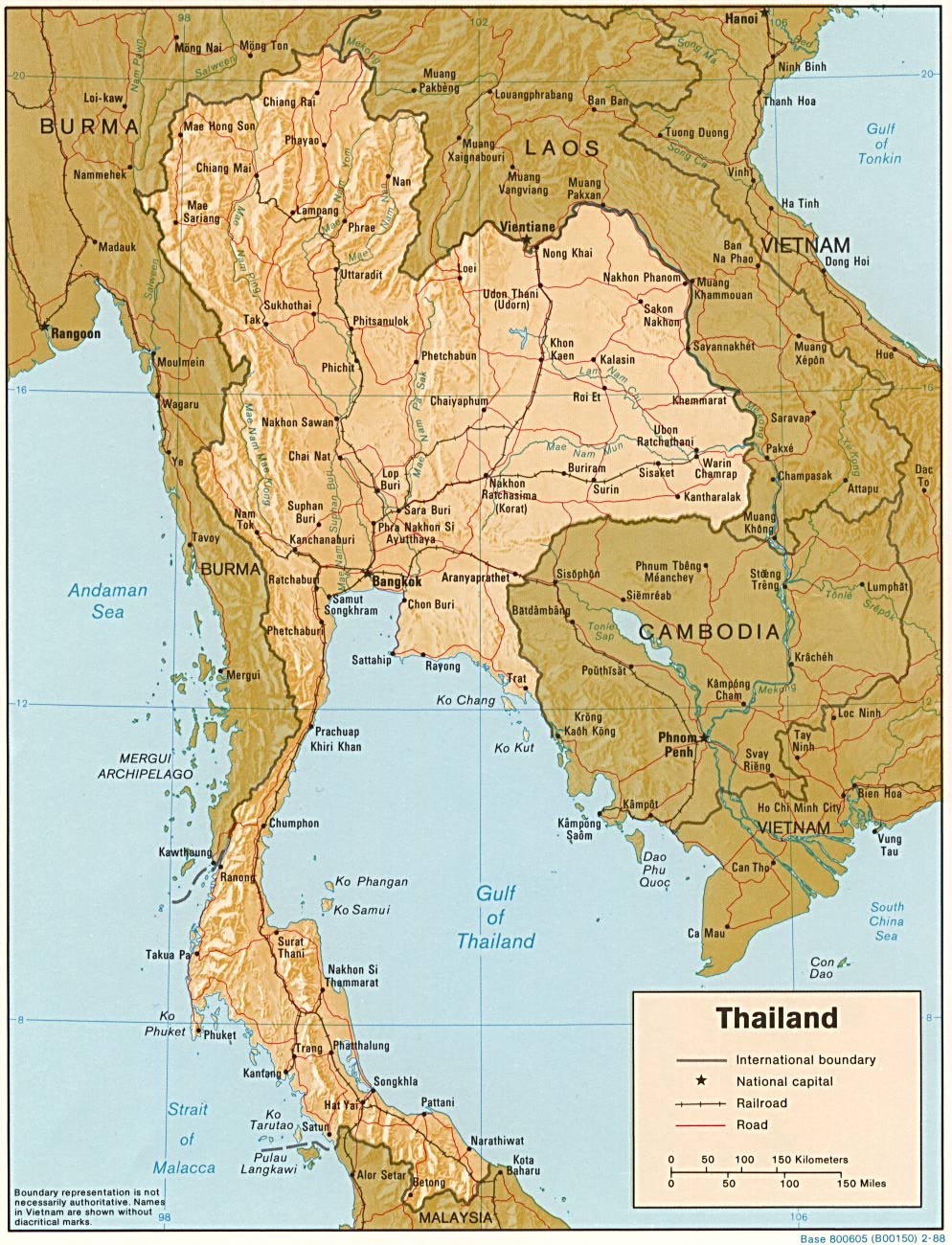
Gulf of Thailand
The Pattaya
Festival in April is a week-long non-stop carnival featuring floral float
parades, beauty contests and firework displays. One of Thailand's most colorful
water festivals is the Rub Bua (receiving the Lotus) Festival, celebrated in
late October at Bang Phli, just south of Bangkok. A locally revered Buddha image
is paraded by barge along the canal while local people shower it with thousands
of lotus buds. Other events include boat races, boxing matches fought on poles
placed across the canal, and likay theatre shows.
Another reason for Buddhism's strength is that there are a few Thai Buddhist
families in which at least one male member has not studied the Buddha's
teachings in a monastery. It has long been a custom for Buddhist males over
twenty, once in their lifetimes, to be ordained for a period ranging from 5 days
to 3 months. This usually occurs during the annual Rains Retreat, a 3-month
period during the Rains Season when all monks forego travel and stay inside
their monasteries.
Meditation is one of the most popular aspects of Buddhism, practiced regularly
by numerous Thais, both monks and lay people, as a means of promoting inner
peace and happiness. Visitors can learn the fundamentals of meditation at
several centers in Bangkok and elsewhere in the country.
Disclaimer:
AsianInfo.org
does not guarantee the complete accuracy of the information provided on
this site or links. Do your own research and get a professional's
opinion before adhering to advice or information contained herein.
Use of the information contained herein provided by AsianInfo.org and
any mistakes contained within are at the individual risk of the user.
(We
do not provide links to, or knowingly promote, any violent or pornographic
sites.)